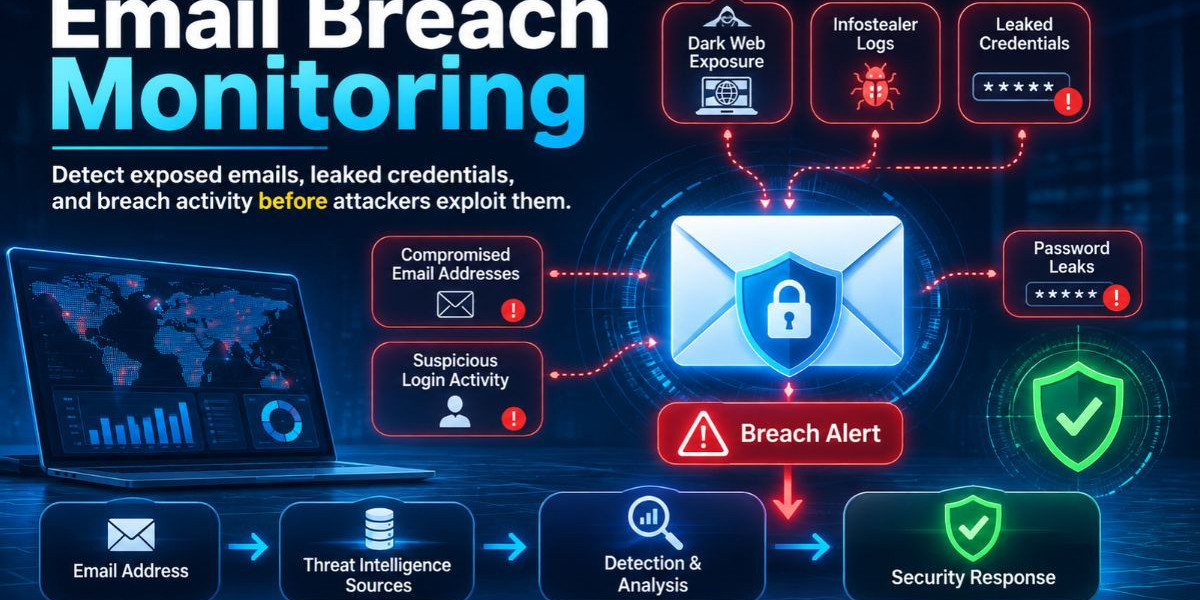

An email address is the key to almost every account a person owns. When that address turns up in a data leak, attackers get a starting point for phishing, password guessing and account takeover. An email breach check tells you whether an address has appeared in a known breach, infostealer log, or leaked credential dump, so you can act before someone else does.Running a single check takes seconds, but the answer shapes what you do next: reset a password, turn on multi-factor authentication, or open an incident for an employee account. For security teams, the value goes beyond one lookup, because it is the first step toward steady email breach monitoring across a whole client base or company.
This guide explains what an email breach check is, how it works, how to run one and what to do with the result. It also covers credential stuffing, responsible use and the difference between a one-time check and continuous email breach monitoring. It is written for MSSPs, MDR providers and IT and security teams, but anyone who wants a clear answer to "has my email been breached" will find it useful.
What Is an Email Breach Check?
An email breach check is a lookup that tells you whether a specific email address has appeared in leaked data. That data can come from a company breach, an infostealer log, a combolist, or a credential dump posted on a breach forum. A positive result means the address and possibly related credentials, were exposed somewhere outside your control.
The term sounds simple, but it covers a few different things, so it helps to be precise.
A breach check looks backward. It tells you what has already leaked.
It works at the address level. You enter one email address and learn whether it shows up in known exposure data.
It does not tell you whether an attacker has used the leaked data. It tells you the data exists and could be used.
You will also see this idea called an email breach checker, email breach lookup, email breach search, or an email pwned check. These all describe the same basic action. Some people phrase it as a question: has my email been breached, or how do I check if an email was breached. The intent behind all of them is identical. The person wants to know if an address is exposed and what to do about it.
An email breach check is different from a full email breach monitoring program. A check is a point-in-time answer. Monitoring is the ongoing process of watching for new exposure and alerting when it appears. Both have a place and later sections compare them side by side.
How an Email Breach Check Works
An email breach check works by matching an address against collections of leaked data gathered from breach forums, infostealer logs, combolist data and public breaches. If the address appears in any of those collections, the check reports an exposure. A well-built check can report this without ever displaying the leaked password itself.
To understand why results vary from tool to tool, it helps to know where the data comes from.
Public breaches
When a company is breached and the data becomes public, researchers and breach-notification services collect it. These are the best-known exposures and they often come with a named source, such as the service that was compromised. Public breach-notification resources, such as the long-running Have I Been Pwned service, have made this kind of lookup familiar to the general public.
Breach forums
Many stolen databases are traded or posted on breach forums before they ever reach a public notification service. Some never become widely known at all. Searching forum data can surface exposure earlier than public sources do, which matters when you want to reset credentials before they are tested at scale.
Infostealer logs
Infostealer malware runs on an infected device and collects saved browser passwords, session cookies and autofill data. The operators package the results into logs and sell or share them. According to security research publications, infostealer logs have become a major source of fresh credentials because they come from live devices rather than old breached databases. An email in an infostealer log often points to a compromised endpoint, not just a compromised website.
Combolists
A combolist is a compiled file of email and password pairs, usually assembled from many earlier breaches and logs. Attackers load these into automated tools to test logins across many sites. Combolists are often recycled, so old exposure can resurface in new lists. An address that appears in a combolist has been circulating in the places attackers actually use.
What the check does with your input
A responsible tool uses the address only to run the lookup. It does not need to build a list of addresses or keep a marketing database and it should not show you the leaked password itself. Showing a password would turn a defensive tool into a convenience for attackers. If you are evaluating any tool, read its privacy policy for exact data handling rather than relying on a summary.
How to Check If an Email Has Been Breached
To check if an email has been breached, enter the address into a breach lookup tool, review whether it appears in breach, infostealer, or credential dump data and then act on the result. The whole process takes a few minutes. Follow these steps for a clean, repeatable routine.
Confirm that you are allowed to check the address. Use your own accounts, or accounts you are authorized to monitor, such as employee emails at a company you manage.
Start with a free lookup tool that supports the first stage of email breach monitoring. The Mispar tool is free and needs no signup, which removes friction for a quick lookup.
Enter one email address. The Mispar tool checks one email at a time, so a team reviewing several addresses should run them individually.
Read the result. Note whether the address appears in a breach, an infostealer log, or a credential dump, since each one calls for a slightly different response.
Record what you find. For a company, log the address, the date of the check and the type of exposure so you can track follow-up.
Act on the result using the response plan in the next section.
Repeat the check on a schedule, or move to ongoing email breach monitoring, because new leaks appear all the time.
A few practical notes make the routine more useful.
A clean result is good news, but it is not a permanent guarantee. It means the address was not found in the data the tool searches at that moment.
A positive result is not a verdict that your account has been taken over. It means the address was exposed and deserves attention.
Check addresses that matter most first: administrator accounts, finance contacts, executives and shared mailboxes.
The right habit is to treat the check as routine hygiene, the same way you treat patching or access reviews.
Credential Stuffing Explained
Credential stuffing is an automated attack where criminals take leaked email and password pairs and try them against other websites and services. It works because many people reuse passwords. OWASP describes credential stuffing as a leading threat for exactly this reason and it is the main reason a breach on one site can lead to a compromise on another.
Here is how the chain usually unfolds.
A service is breached, or a device is infected by an infostealer and credentials leak.
The credentials end up in breach forums, infostealer logs, or combolists.
Attackers feed those lists into automated tools that try each pair against many login pages.
Wherever a person reuses a password, the attacker gets in.
This is why an email breach check matters even when the breached site seems unimportant. A forgotten forum account with a reused password can expose a corporate mailbox. The email address links your accounts together, so exposure of that one address raises risk across everything tied to it.
Password reuse and weak authentication are what make this attack scale. Multi-factor authentication blunts it significantly, because a correct password alone is no longer enough. Unique passwords stored in a password manager remove the reuse problem at its root.
What to Do If an Email Shows Up in a Breach
If an email shows up in a breach, change the password for that account, change it anywhere it was reused, turn on multi-factor authentication and review recent account activity. For a company, also check the device for infostealer malware, because a leaked credential from an infostealer log signals a compromised endpoint.
Work through the response in order.
Change the password on the affected account right away. Use a long, unique password that you have never used anywhere else.
Change the password on every other account that shared it. Start with email, banking and anything connected to work.
Turn on multi-factor authentication wherever it is offered. Prefer an authenticator app or a hardware key over text messages when you can.
Review account activity. Look for logins you do not recognize, new forwarding rules in the mailbox, changed recovery details and unfamiliar connected apps.
Scan the device. If the exposure came from an infostealer log, the device that saved the credential may still be infected. Changing passwords from an infected machine does not solve the problem, because the malware can capture the new password too.
Revoke active sessions. Stolen session cookies can let an attacker in without a password, so sign out of all sessions after you change credentials.
Watch for phishing. Leaked addresses are often used in targeted phishing, so treat unexpected messages with extra suspicion for a while.
For security teams, add a few organizational steps.
Open a ticket and assign an owner, so the exposure does not sit unreviewed.
Force a reset and session revocation for the affected employee.
Check whether the same address appears in other exposure data and whether other staff share the same exposed service or device type.
Document the timeline in case the exposure is later tied to an incident.
NIST password guidance is useful here. It supports checking passwords against lists of known compromised values and favors changing a password when there is evidence of compromise, rather than forcing frequent changes for no reason. A breach hit is exactly that kind of evidence.
Why Security Teams and MSSPs Need Email Breach Checks
Security teams and MSSPs need email breach checks because leaked credentials are one of the most common routes attackers use to get into a network. A fast lookup lets an analyst confirm exposure, reset the right accounts and close the gap before an attacker uses the credentials. For an MSSP, it also becomes a repeatable service for clients.
Here is why the check earns its place in a security workflow.
Leaked credentials lower the cost of an attack. An attacker with valid credentials does not need to exploit anything. They simply log in, which can look like normal activity.
Email is the recovery path for other accounts. Control of a mailbox often means control of password resets everywhere else.
Employees reuse passwords across work and personal accounts. A personal breach can become a company risk without anyone noticing.
Infostealer exposure points at endpoints. A hit can reveal a compromised device that existing tools missed.
Clients ask the question directly. MSSPs and MDR providers are regularly asked whether a client or executive has been exposed and a quick check gives a concrete starting answer.
For MSSPs, a one-off lookup is a useful opener in a client conversation, but it is not the end state. Clients expect ongoing coverage. This is where the platform context matters. Mispar's Live Search lets a team check any email, domain, or username on demand and the Watch List catches new leaks automatically after that. That pairing reflects the real workflow: look up what is exposed now, then keep watching for what appears next.
This is also where corporate email breach monitoring and business email breach monitoring come in. A company rarely cares about one address. It cares about every address on its domain, including shared mailboxes, service accounts and contractor accounts. Ongoing coverage is what turns scattered lookups into a program.
Responsible Use and Authorization
You should run an email breach check only on your own accounts or on accounts you are authorized to monitor, such as employee emails at a company you manage. The Mispar tool does not require proof of ownership, but that does not remove your responsibility to use it appropriately. Checking other people's addresses without a legitimate reason is poor practice and can raise legal and ethical problems.
A few principles keep your use clean.
Use a check to protect people, not to profile them. The goal is to reduce risk, not to build a file on someone.
Get authorization before checking staff addresses in bulk or on a schedule and make sure policy covers it.
Handle results carefully. A breach hit is sensitive information about a person. Share it only with those who need it to respond.
Do not use results to pressure or embarrass anyone. Employees are more likely to report problems if exposure is treated as routine and blameless.
If your work touches OSINT, the same rule applies. Passive research is a normal part of security practice, but it still needs a purpose, a boundary and a record of why it was done.
Key Features to Look For in an Email Breach Check Tool
A good email breach check tool searches broad sources, explains what it found, protects your input and does not expose sensitive data. Before you rely on any tool, test it against a short list of qualities. These apply whether you use a free tool for a quick lookup or evaluate a full email breach monitoring platform.
Source coverage
Look for a tool that searches more than one kind of source. Public breaches alone miss a lot. Coverage of breach forums, infostealer logs and combolist data gives a fuller picture of what has actually circulated.
Clear, usable results
A result should tell you whether the address was found and what kind of exposure it was. A vague pass or fail is not enough for a security team that needs to decide between a password reset and an endpoint investigation.
No leaked password display
A tool should never show you the leaked password itself. Displaying plaintext credentials adds risk with no defensive benefit and it can encourage careless handling.
Privacy and data handling
Check what the tool does with the address you enter. The best practice is to use it only to run the check and not to build a list. For exact handling, read the privacy policy rather than guessing.
Low friction
Free access with no signup matters for a quick lookup. If a security analyst has to create an account before running a single check, they will use something else.
A path to ongoing monitoring
A one-time check answers today's question. A tool or platform that also offers continuous watching for new leaks helps you answer tomorrow's. Treat this as a sign of maturity, not a requirement for every user.
Honest limits
Be wary of tools that make big claims about perfect coverage. No breach data source is complete and a tool that admits its limits is easier to trust.
Email Breach Check vs. Continuous Email Breach Monitoring
A one-time email breach check gives you a quick answer about past exposure, while continuous email breach monitoring watches for new exposure and alerts you as it happens. The table below compares them with manual OSINT research, which some teams still use, so you can see where each approach fits.
Factor | One-time email breach check | Continuous email breach monitoring | Manual OSINT research |
Purpose | Answers whether an address has already leaked | Catches new leaks as they appear | Investigates exposure by hand across sources |
Timing | Point-in-time result | Ongoing and automatic | Depends on analyst availability |
Effort | Very low, one address at a time | Low after setup | High and hard to repeat consistently |
Best for | Quick lookups and first conversations | Teams and MSSPs covering many addresses | Deep investigations of a specific incident |
Main limit | Becomes outdated as new leaks appear | Needs setup and a process for alerts | Slow and difficult to scale |
Typical user | Individuals and analysts doing a fast check | Security teams, MSSPs and MDR providers | Threat researchers and investigators |
The takeaway is that these approaches complement each other. Start with a check to learn where you stand. Move to continuous email breach monitoring when you need to keep that answer current across many addresses. Reserve manual research for cases where you need context a tool does not provide.
Free vs. Paid Email Breach Tools
Free email breach tools are best for fast, single lookups, while paid platforms suit teams that need ongoing coverage, scale and workflow support. Neither is automatically better. The right choice depends on how many addresses you cover and how quickly you need to respond to new exposure.
A free tool fits when:
You want to check your own address or a single employee address.
You need a fast answer without creating an account.
You are testing whether breach checks belong in your workflow.
A paid platform fits when:
You manage many addresses, domains, or clients and need coverage that does not depend on someone remembering to run a lookup.
You need alerts when a new leak appears, so response is not delayed.
You want results tied into reporting and client conversations.
Be careful with the word free. A free tool should still be clear about how it treats your input and a paid tool should still be honest about what it covers. Price is not a measure of data quality in either direction. Read what each tool says it searches, how it handles your data and what it leaves out.
Common Mistakes When Checking Email Breaches
The most common mistake is treating a clean result as permanent safety and the second is treating a positive result as proof of compromise. Both misread what a breach check actually says. Avoiding a few other habits will make your process stronger.
Checking once and never again. New leaks appear continuously, so an old clean result loses value over time.
Resetting only one password. If the credential was reused, the other accounts are still exposed.
Ignoring the device. When an infostealer log is involved, a password change on an infected machine can be captured again.
Skipping multi-factor authentication. A reset without a second factor leaves the account open to the next leak.
Checking addresses without authorization. Use your own accounts or ones you are permitted to monitor.
Sharing results too widely. A breach hit is sensitive, so limit who sees it.
Forgetting shared and service mailboxes. These are often the weakest accounts and the least watched.
Relying on one source. Because data sits across public breaches, forums, logs and combolists, a single narrow source can miss exposure.
Interesting Facts About Email Breaches
The facts below come from general, well-established sources. Where a precise figure would require a specific report, the facts are described by source type instead, so nothing here is invented.
OWASP describes credential stuffing as the automated use of leaked username and password pairs against other sites and it depends heavily on people reusing passwords.
NIST password guidance recommends checking chosen passwords against lists of known compromised values and it favors changing passwords when there is evidence of compromise rather than forcing routine changes.
According to security research publications, infostealer malware commonly collects saved browser credentials, autofill data and session cookies, which is why infostealer logs are a major source of fresh credentials.
According to industry breach reports, such as annual data breach investigations reports, the use of stolen credentials is consistently among the most common ways attackers gain initial access.
Public breach-notification services, including the independent Have I Been Pwned project, have made email breach lookups familiar to ordinary users and helped normalize the habit of checking.
Security researchers note that combolists are often rebuilt from older breaches and logs, so exposure from years ago can resurface in newer lists.
Conclusion
An email breach check is the fastest way to learn whether an address has been exposed in a breach, infostealer log, or leaked credential dump. It gives you a clear starting point: change the password, turn on multi-factor authentication, check the device and watch for phishing. For individuals, that single lookup can head off an account takeover. For security teams and MSSPs, it is the entry point to a broader habit of email breach monitoring.The key points are simple. A check shows what has already leaked, credential stuffing turns that leak into real risk through password reuse and a clean result today does not guarantee a clean result next month. Use the free check for quick lookups on accounts you are authorized to review and move to continuous coverage when you need to keep pace with new exposure. To see how this fits into a wider exposure workflow, explore what Mispar offers for MSSPs and security teams.
Frequently Asked Questions (FAQs)
How do I check if my email has been in a data breach?
Enter your email address into a breach lookup tool and review whether it appears in breach, infostealer, or credential dump data. A free email breach check with no signup takes only a few seconds. Then change any affected passwords and turn on multi-factor authentication.
Is a free email breach check safe?
A free email breach check is generally safe when the tool uses your address only to run the lookup and never shows leaked passwords. Read the privacy policy for exact data handling. Avoid any tool that asks for your password or sensitive details.
What should I do if my email was leaked?
Change the password on the affected account and on any account that shared it, turn on multi-factor authentication and review recent activity. Scan your device for malware, revoke active sessions and stay alert for phishing messages that use your leaked address.
Can I check someone else's email address?
You should only check your own accounts or accounts you are authorized to monitor, such as employee emails at a company you manage. Some tools do not require proof of ownership, but responsible use still means having a legitimate, permitted reason.
What is credential stuffing?
Credential stuffing is an automated attack that tries leaked email and password pairs against many websites. It succeeds when people reuse passwords across accounts. Unique passwords and multi-factor authentication are the strongest defenses against it.
Does a leaked email mean my password was stolen?
Not always. A leaked email means the address appeared in exposed data, but the password may or may not have been included. Because you cannot be sure, treat the exposure as a warning and change the password, especially if you reused it elsewhere.